Eigenfolds

9600 on-chain Pisot fractals — a complete enumeration of every variation of every family, in every palette, at every density. Browse the visualiser, find the one you want, mint it directly.

9,600 pieces0 minted9,600 availableprice $15 · ≈ 0.0069 ETHcontract 0x…
loading…
drag to orbit · scroll to zoom

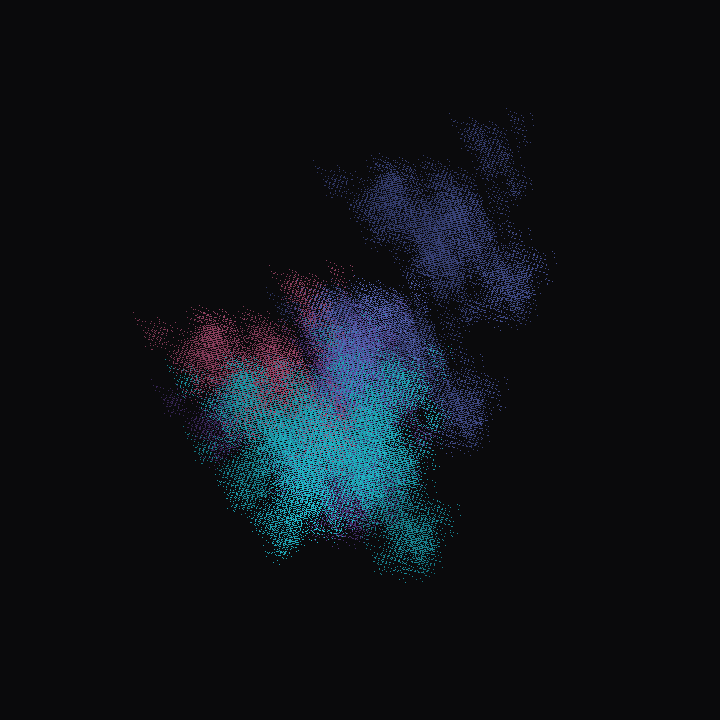
Eigenfolds is a complete enumeration of three-dimensional fractals generated from four-letter Pisot substitution rules. Every piece begins with a substitution σ on the alphabet {a, b, c, d} whose 4×4 abelianisation matrix satisfies the Pisot condition - one expanding eigenvalue β > 1, three contracting eigenvalues strictly inside the unit disk. Iterating σ produces a word of hundreds of thousands of letters; tracking the running count of each letter gives a path in four-dimensional integer space; projecting that path onto the three-dimensional subspace spanned by σ's contracting eigenvectors produces a self-similar fractal volume - four interlocking pieces, one per letter.

Four families × one hundred variations × six palettes × four densities = nine thousand six hundred pieces.

The four characteristic polynomials:

Tetranacci · x⁴ − x³ − x² − x − 1 · β ≈ 1.93Pillar · x⁴ − 2x³ − 1 · β ≈ 2.11Hawthorn · x⁴ − 2x³ − x² − 1 · β ≈ 2.47Bowed · x⁴ − 2x³ − x² − x − 1 · β ≈ 2.59

Within each family, one hundred distinct 4×4 non-negative integer matrices share the family's characteristic polynomial - same eigenvalues, same Pisot algebra, different eigenvectors, different shape. Each shape is rendered in six colour worlds (Aurora, Sunset, Ocean, Ember, Forest, Bone) at four densities (22,000 to 300,000 points). Every combination is its own piece. There is no randomness in the assignment, no curation, no scarcity by accident: every Pisot fractal in this parameter space is present, exactly once.

The token ID encodes the parameters directly. Reading token #1234 as a base-100/24/4 decomposition tells you exactly which family, variation, palette and density it is. The contract stores nothing per token. Open a piece and the algorithm runs from the bytecode, computing the substitution iteration, the spectral decomposition, the eigenplane projection, and the rotating render from scratch every time.

This is not a curated drop. Browse the visualiser, change the four sliders, watch the parameter space rotate through itself, and when something catches your eye, mint it directly on Verse.

Pieces are named in order of minting - the first piece minted is Eigenfold #1, the second is Eigenfold #2, and so on, regardless of which token ID was chosen. The parametric identity (family, variation, palette, density) is preserved as on-chain traits and as the token ID.